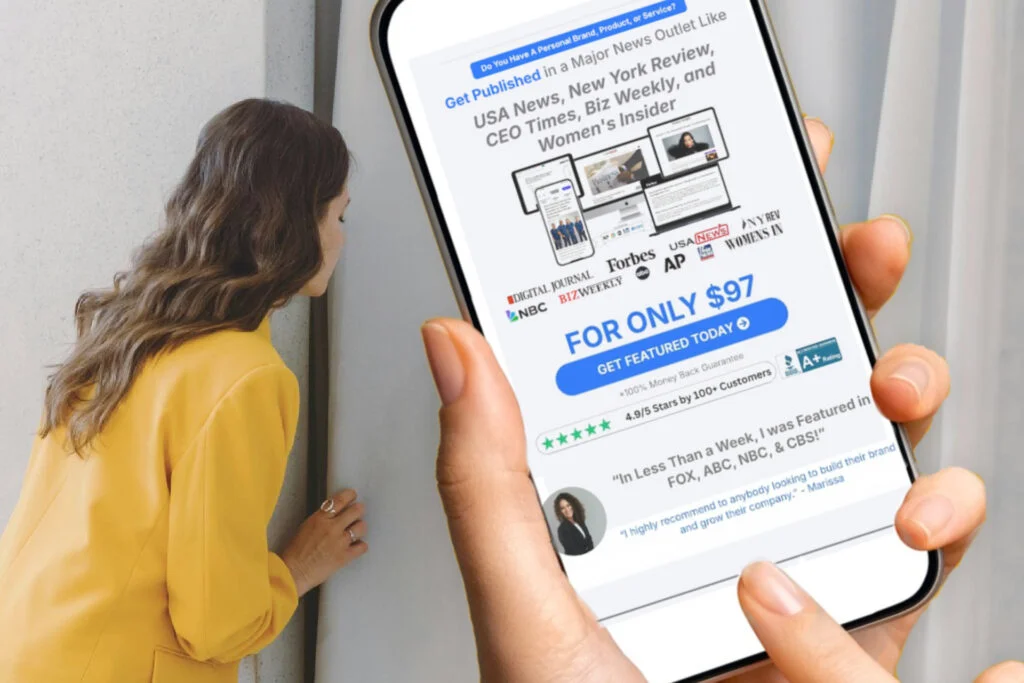
Have you seen ’em? Incredible PR deals are popping up all over social media: NATIONAL MEDIA COVERAGE for just $97! They guarantee that my personal brand, product, or service will be published in a Major News Outlet “like USA News, New York Review, Women’s Insider” and other names I sort of recognize.
Even better: all it takes is two questions.
Two! Questions! That’s all they need to spin my story into what they call a “compelling article,” guaranteed to boost SEO presence as thousands of satisfied customers will attest. Indeed, their website features an endless scroll of short video testimonials that certainly seem convincing. They even have an A+ BBB rating.
What’s to lose? It’s less than a hundred bucks, and just a few minutes of my time. If this service was legit, it could be a real game-changer for the small businesses and nonprofits we work with every day.
I was so tempted! Even just for curiosity’s sake, it seems like a bargain. Then again, information is free, so let’s start with a deep dive into the murky waters of “guaranteed placements”…
Paid Placements vs Earned Coverage
Here’s the thing: if a media placement is guaranteed, then it’s not really coverage — it’s a purchase.
Paid placements are essentially ads that look like articles. You’re not being interviewed. No journalist is digging into your story. Your content is just slotted into a syndication network — often with little or no human review — and published in a way that looks like editorial but functions more like fluff.
Procured coverage isn’t inherently shady. It can certainly have a role in a larger strategy. Press releases, sponsored posts, and promotional announcements can all make sense in the right context.
But it’s important to understand the difference:
- Earned media is when a journalist or editor chooses to cover your story because it’s timely, relevant, or compelling. This kind of press builds credibility because it wasn’t bought — it was earned.
- Paid media, on the other hand, is a form of advertising. It might appear in legitimate outlets, but it’s often clearly marked as “sponsored” or buried in obscure affiliate pages with minimal visibility.
And despite what the $97 crowd might claim, most readers can tell the difference.
After years of ad exposure, Americans are surprisingly good at spotting content that’s more pitch than story. We see a lot more of it than they do in Europe, where the Code de Lisbonne explicitly prohibits outlets from guaranteeing press coverage, because it blurs the ethical line between journalism and advertising.
Not in the US, though! Paid placements remain a valid option, especially social media promotions. But unless that $97 press is part of a bigger strategy, the results will likely be only short-term, if they’re seen at all.
The Illusion of Exposure
These super budget PR packages use syndication networks with low-traffic, affiliate-linked sites that technically count as “media” but provide very little actual traffic.
Sure, you’re “featured in the news.” You’ll get a live link – maybe even several. The article will probably be nicely laid out on the page. But here’s what’s missing:
- A real audience
- An authentic story
- Organic traffic
- Any meaningful SEO lift (despite the sales pitch)
Instead, these “articles” often live on ghost-town websites or subdomains attached to obscure affiliates. No one’s reading them, and they’re not designed to be shared — just to exist, for your screenshot or badge.
So Who Is This Really For?
If you’re a solo coach looking to add some sparkle to a website, or you just need something to slap on a sales page — it could do. But if you’re a nonprofit trying to build trust, or a local business seeking genuine visibility, these kinds of shortcuts rarely deliver.
At best, they’re smoke and mirrors. At worst, they can feel misleading — especially if funders or supporters click through to find a content graveyard full of pop-ups and spam.
So Is It a Scam?
Not exactly. It’s more like a magic trick — built on suggestion and presentation. You’re paying for the appearance of press, not the real thing. And for small orgs with tight budgets, I think that distinction really matters.
Worth Remembering
If it sounds too good to be true, it probably is — especially when it promises press. Real visibility takes more than a credit card.
P.S. Curious about what real storytelling looks like?
There are tons of ways to tell your story — honestly, affordably, and effectively. Want to talk about options that actually work? Shoot us an email at [email protected] (Pro Tip: our newsletter sometimes includes local networking opportunities).